

What this is about
This article is part of our Strategy & Frameworks topic cluster — an overview of all articles on frameworks, models, and cognitive biases in digital business.
If you grew up with a marketing textbook, you know them by heart: Product, Price, Place, Promotion — the classic 4P by Jerome McCarthy from 1960. For a long time they were considered the unshakeable blueprint for every marketing strategy. Anyone who relies on them alone today, however, is building their marketing on a foundation from the 1960s — before the internet, before social media, before customer reviews, and before any form of real customer power.
The evolution of the framework is remarkable:
- 1960 — McCarthy's 4P: marketing from the company's perspective
- 1981 — Booms and Bitner extend the model for service industries to 7P (People, Process, Physical Evidence)
- 1990 — Robert Lauterborn formulates the 4C: the same four dimensions, but from the customer's perspective
- 2010s to 2020s — the 4C are extended by three further dimensions — Community, Customer Care, Credibility — analogous to the 7P extension. This gives rise to the 7C model
This 7C model is the more modern blueprint for SME marketing in 2026. In this article you'll get:
- A short refresher on the evolution 4P → 7P → 4C → 7C
- For each dimension: what it means from the customer's perspective, what's different from the classic P counterpart, and a concrete example that makes the perspective shift tangible
- How you as a Swiss SME can operationalise each of the seven dimensions
- Where Generative AI provides leverage in each dimension
- Practical tips for introducing the model in your own team
Where the 4C model sits in digital marketing theory
The 4Cs aren't our invention — they go back to Robert Lauterborn (1990) and were established in the 2000s as a response to the brand-centric 4P model. Chaffey & Ellis-Chadwick in the 8th edition of Digital Marketing (2022) develop the expansion into customer-centricity frameworks in depth and add concepts like Community, Customer Service, and Credibility — which we have consolidated in our 7C model. What we add to that: the Swiss SME adaptation with concrete pain-first examples per dimension.
Why the perspective shift from 4P to 7C is decisive
The 4P are sender-oriented: "We have a product, we set a price, we choose a distribution channel, we promote all of it." The customer is a recipient at the end of the chain.
The 4C turn the perspective around by 180 degrees: "What does the customer want? What effort does she incur? How easily can she buy? What dialogue does she have with us?" The customer stands at the beginning of every consideration.
The additional three Cs — Community, Customer Care, Credibility — address what additionally shapes marketing in 2026: social networks, lifecycle care, and trust-building proof from the customer's perspective. These three made no sense in the 1960s in the mass-communications world — today they are constitutive for modern purchase decisions.
Anyone running marketing as a Swiss SME today and ignoring the 7C is selling products instead of nurturing relationships. Relationships last longer, are less price-sensitive, and produce referrals that in turn make acquiring new customers easier.
The 7C model in detail — seven dimensions with examples
1. Customer Experience (instead of Product)
What it means from the customer's perspective: The customer is not buying a product. She is buying an overall experience — from the first perception of your brand through consultation, purchase, use, all the way to aftercare. Every one of these touchpoints shapes whether she comes back and whether she recommends you.
Difference from classic Product thinking:
- 4P thinking: "We have developed a good product. What features does it have, which competitors are there, how do we position it?"
- 7C thinking: "What experience journey does the customer have with our offering — and where does she encounter friction, frustration, or confusion?"
In the 4P model, the product is the centre. In the 7C model, the experience journey is the centre, and the product is one part of it — important, but not the entire value.
Concrete example — a Swiss furniture maker in the Bernese Oberland:
A furniture maker who builds dining tables from regional wood can think about her business in two ways:
- 4P style: "We make handcrafted oak tables, price from CHF 4,500, sold via the workshop and online shop, advertised via Instagram and ads in home magazines."
- 7C style: "The customer goes through a journey — she first sees an image of a table in an inspiring living setting on Pinterest, then our website with a story about the wood, then a first conversation in the workshop with a wood-sample selection, then the custom-build process with photo updates, then the delivery as an experience moment, then the onboarding for care, then the annual care mailing with tips. Which part of this journey deserves the most attention?"
The answer from the 7C logic is usually: not the product itself, but the experience moments around it. That is exactly where the recommendation to friends comes from — and with it, the next sales opportunity.
SME practical tip: Map the customer journey of your key segments in a workshop using the STDC model. For each phase, ask: "What experience does the customer have here — and what should she have?" For every gap, note an improvement measure.
2. Cost (instead of Price)
What it means from the customer's perspective: Price is only one component of cost. Beyond it, the customer bears time effort, mental load, switching costs, learning effort, opportunity cost, and emotional risk. Anyone optimising only price overlooks the costs that often weigh more heavily for the customer.
Difference from classic Price thinking:
- 4P thinking: "What does comparable competition cost, where do we position ourselves in the market, what discounts do we run?"
- 7C thinking: "What total effort does the customer incur if she chooses us — money, time, learning curve, switching pain — and where can we reduce these costs?"
Concrete example — a SaaS provider for SME accounting:
Imagine two competitors in the SME accounting market:
-
Provider A (4P-oriented): CHF 49/month, full feature scope, "lowest price on the market". Migration from Excel: the customer has to do it herself, about 30 hours of effort. Training: a 4-hour online tutorial. If something doesn't work: email support with a reply in 2–3 days.
-
Provider B (7C-oriented): CHF 79/month. Migration: in the first two weeks, a Customer Success Manager comes in and takes over the data migration from Excel for free. Training: a 90-minute 1:1 onboarding call plus two follow-ups in the first 60 days. If something doesn't work: chat support with a reply in 15 minutes.
Which provider is cheaper from the customer's perspective? Provider A saves CHF 30/month. Provider B saves the customer 30 hours of her own effort plus emotional stress during migration. At an average SME employee cost rate of CHF 80/h, that's CHF 2,400 in migration plus additional comfort.
The 4P view says: "Provider A is cheaper." The 7C view says: "Provider B is significantly cheaper if you honestly compute total cost of ownership."
SME practical tip: In every pricing discussion in the team, ask the question: "What does our offer cost the customer beyond price?" This question often opens up the view to service components that you can integrate into your offering and that significantly raise your perceived value — without the bare price having to change.
3. Convenience (instead of Place)
What it means from the customer's perspective: It's not about where you sell, but how easy it is for the customer to get and use your offer — in her life context, with her devices, in her time.
Difference from classic Place thinking:
- 4P thinking: "Where do we distribute? What sales channels do we have, which stores, which marketplaces?"
- 7C thinking: "What friction does the customer experience on the way to and during the use of our offering?"
Concrete example — a Swiss neighbourhood bakery:
-
4P style: The bakery has a nice shop, a good location, long opening hours. The customer has to come, queue, order, pay, leave. At rush hour, 15 minutes spent.
-
7C style: The bakery also has a simple app with pre-ordering. The customer orders the bread for lunch in the morning, chooses a pickup slot from 11:45 to 12:00, pays directly in the app. She walks in, the bread is on the counter with her name on it, she takes it with her. 90 seconds spent.
The product is identical. The location is identical. But convenience from the customer's perspective is a different world. The customer becomes a regular because she no longer loses her lunch break in the bakery.
SME practical tip: Do a simple stopwatch exercise per touchpoint of your customer journey — "How long does the customer take from desire to fulfilment?" Identify the two longest waiting times and reduce at least one of them by 50% in the next 90 days.
4. Communication (instead of Promotion)
What it means from the customer's perspective: It's not a monologue, not a campaign, not a spot. It's a dialogue. The customer speaks, you listen. You speak, she replies. Ideally, the dialogue runs in both directions, contextually, and at the moment of relevance.
Difference from classic Promotion thinking:
- 4P thinking: "What advertising messages do we send, over which channels, with what frequency budget?"
- 7C thinking: "How do we conduct a dialogue with the customer — where, when, on which topics, in which language?"
Concrete example — a personal-brand coaching SME:
-
4P style: Coach runs LinkedIn ads with a lead magnet ("Get my white paper on personal branding"). Collects email addresses. Sends a standard newsletter to everyone every Thursday. Measures open rates.
-
7C style: Coach posts twice a week on LinkedIn with a clear professional position. Replies individually to every comment. For a qualified lead (defined via engagement patterns), he opens a 1:1 dialogue with a question tailored to that lead. The newsletter is not a bulk mailing but is segmented by industry and maturity level — with content adapted per segment.
The difference is not between gut feeling and data — the difference is between a channel that broadcasts one-way and a channel that listens, replies, and responds to the individual situation.
SME practical tip: On each of your active marketing channels (newsletter, LinkedIn, Instagram, etc.), establish a weekly rhythm in which you invest at least 30 minutes in incoming comments, DMs, and replies — not in sending, but in answering. That's where real dialogue arises. You'll find more levers in our practical levers for SME marketing.
5. Community (instead of People)
What it means from the customer's perspective: The customer doesn't decide in a vacuum. She is part of communities — friends, colleagues, online forums, review platforms, industry networks. These communities shape her perception of your brand more than any advertising message.
Difference from classic People thinking (from 7P):
- 7P thinking (People): "We train our employees so they can deliver service quality." (Focus: employees internal)
- 7C thinking (Community): "We understand the communities in which our customers move — where do they get their information, whom do they trust, which discourses shape their opinion formation?" (Focus: communities external)
Both aspects are important — but the Community C complements from the customer's perspective what People P addresses from the company's perspective.
Concrete example — a Swiss organic farm shop:
-
4P/7P style: The farm shop trains its sales team in product knowledge and friendly communication. Very good. But that's it. Outward marketing runs via classic advertising channels.
-
7C style: The farm shop understands that its customers move in several communities: a Facebook group for regional organic consumers, a Swiss Slow Food association, local WhatsApp groups for weekly-market tips. The farm shop is actively present in all of these communities — not as an advertising driver, but as a useful contribution provider (recipes, farm stories, background knowledge). It also nurtures active regular-customer meetups four times a year.
The result: when a new potential customer searches for "good organic farm shop in the region", the farm shop appears organically in several discussion threads, recommendations, and stories — through communities that enjoy trust precisely because they are not controlled by the brand itself.
SME practical tip: Do a 60-minute team exercise: "Which five communities shape the opinion formation of our key customers?" Per community: are you visible there? Are you helpful there? Do you have a voice there? If no to all three: a concrete plan within the next 30 days to enter at least one of these communities — as a value provider, not as an advertising actor.
6. Customer Care (instead of Process)
What it means from the customer's perspective: The purchase is not the end — it is the start of a relationship. Customer Care means systematic, high-quality care of the customer over the entire lifecycle: onboarding, usage phase, support, repurchase, referral.
Difference from classic Process thinking (from 7P):
- 7P thinking (Process): "We have efficient internal workflows for order fulfilment, service delivery, complaint handling." (Focus: internal efficiency)
- 7C thinking (Customer Care): "How does the customer experience the ongoing care from us — how is she onboarded, how is she continuously nurtured, how is she supported, how is she made aware of repurchase opportunities?" (Focus: lifecycle relationship care)
Concrete example — a B2B SaaS provider for SME HR management:
-
4P/7P style: Sales closes the contract. A welcome email with login is automatically sent. If the customer doesn't say anything, she's apparently satisfied. If there are problems, she'll get in touch.
-
7C style: After contract signing, the customer receives a structured onboarding in the first 30 days with three fixed 1:1 calls (day 1: setup, day 7: first results, day 30: optimisation). After 90 days, a quarterly conversation with the Customer Success Manager who has proactively prepared optimisation recommendations. In case of usage anomalies (sudden drop in activity), automated but contextual re-engagement measures. After 12 months, an annual conversation to prepare renewal with a real value balance.
The result: churn rate halved, Net Promoter Score significantly higher, upgrade rate in the first contract year considerably increased. From the customer's perspective: she feels seen and cared for, not ticked off a list.
SME practical tip: For your two most important customer segments, define a clear customer lifecycle with at least three actively triggered touchpoints after the initial purchase (onboarding, mid-cycle check-in, renewal preparation). You'll find more on marketing-automation setup in our marketing-automation tool article.
7. Credibility (instead of Physical Evidence)
What it means from the customer's perspective: Before the customer buys, she looks for proof that your offer delivers what it promises. From the customer's perspective, this proof does not come from your marketing materials — it comes from independent sources, other customers, trustworthy voices.
Difference from classic Physical Evidence thinking (from 7P):
- 7P thinking (Physical Evidence): "We have a professional office, a thoughtful brand identity, high-quality materials." (Focus: self-staging)
- 7C thinking (Credibility): "What external trust proof do we have that the customer uses to reassure herself before buying — reviews, testimonials, case studies, awards, media mentions, industry certificates?" (Focus: external proof)
Concrete example — a Swiss plumbing crafts business:
-
4P/7P style: The plumbing business has a modern website with professional images. On the home page there are marketing slogans like "Fast, clean, reliable — your professional for plumbing technology." Four-star reviews on Google? Not actively promoted, but probably there.
-
7C style: Website with clear trust layers: prominently embedded Google reviews with real names (140+ reviews, average 4.8 stars), before-after pictures of 30 completed projects with 2–3 sentences from the customer each, a case-story page with detailed descriptions of difficult renovations, logos of two industry awards from the past three years, references to insurance coverage and SVK certification. Plus: an active strategy of asking for a Google review after every completed assignment.
Which business wins the undecided new customer who has compared two offers and is looking for trust? Clearly the second. The reviews and before-after pictures are externally verifiable proofs that the first business would also have — but doesn't use.
SME practical tip: Do a 60-minute credibility audit of your website: "If I were a new customer and had to build trust in the first impression of this page — what would I base it on?" If the answer is "marketing slogans and nice pictures", credibility is missing. List the five strongest external trust proofs you have — and make them visible.
The 7C along the customer journey — one dimension doesn't work equally everywhere
So far we have described the seven Cs as equally important dimensions. In practice, however, they have different impacts — depending on which phase of the customer journey the customer is in.
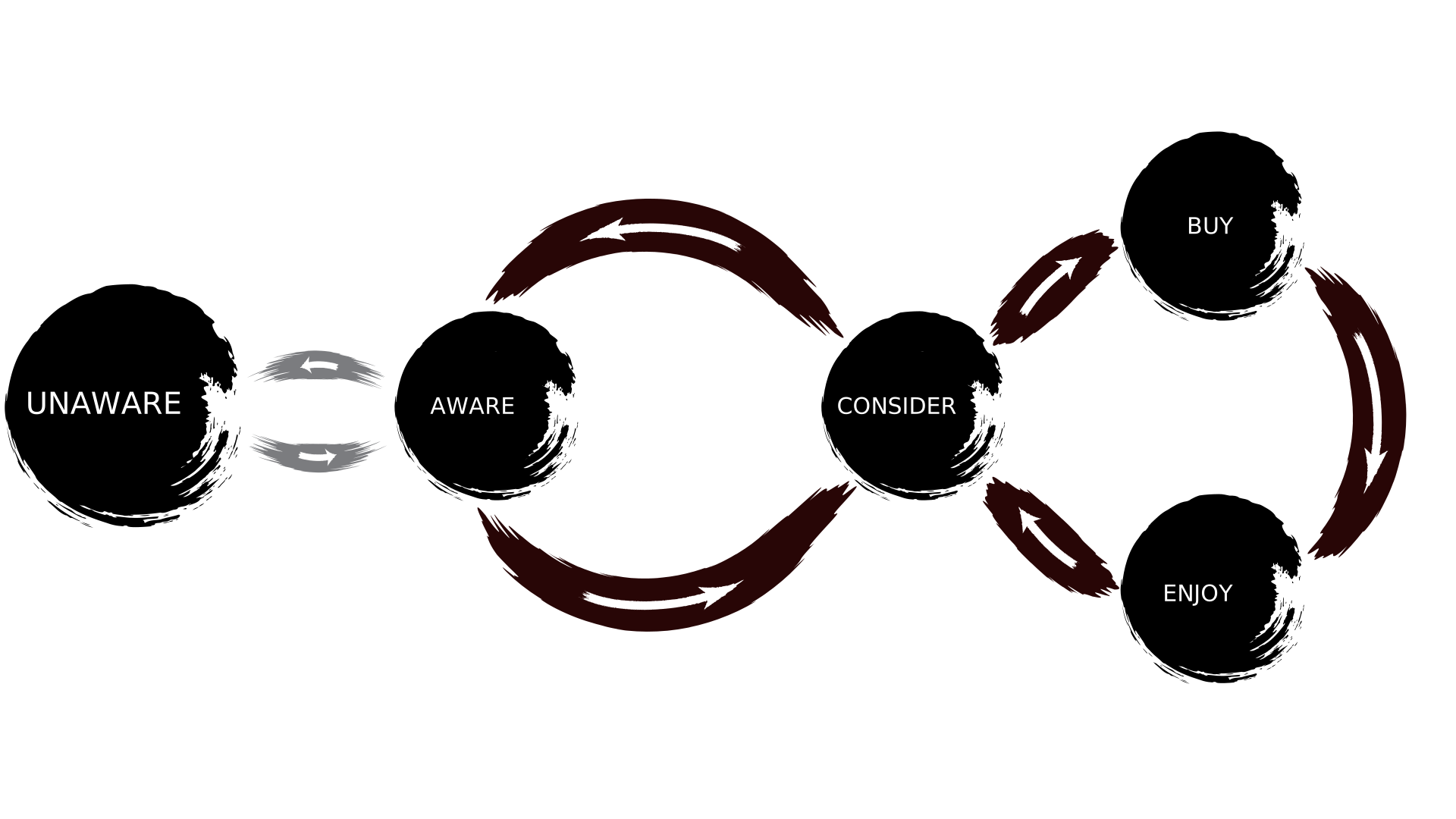
The customer goes through five typical phases:
- Unaware — she doesn't yet know your offer and often hasn't clearly formulated the problem yet
- Aware — she knows that you exist or that a category of solutions exists
- Consider — she evaluates options, compares, seeks opinions
- Buy — she decides and buys
- Enjoy — she uses your offer and silently decides whether she'll come back and recommend you
Each of the seven C dimensions is relevant in every phase — but with different weighting:
- In Unaware, Community and Communication matter most — you need visibility where the customer moves and a speaking style that hits her problem before she names it herself
- In Aware, Customer Experience (the first touchpoints) and Credibility (building trust via reviews and proof) are strongly added
- In Consider, Customer Experience, Cost (total cost of ownership is compared) and Credibility (she actively reads reviews and cases) are central
- In Buy, Convenience (friction at checkout) and again Cost (final price check, possible cart-abandonment triggers) dominate
- In Enjoy, Customer Care moves into the centre — followed by renewed Communication (keeping engagement) and Community (she herself becomes a multiplier in her networks)
In practical terms: a marketing team that operationalises the 7C model cleanly looks not only at whether each dimension is covered — but also whether the weighting per customer-journey phase is right. Anyone who relies on Customer Care in the Unaware phase or on cost optimisation in the Enjoy phase misses the actual lever.
If you want to get to know the phase logic more deeply, you'll find the corresponding phase theory in the STDC model for SME marketing (See-Think-Do-Care as a related four-phase model), including concrete measure recommendations per phase.
How SMEs operationalise the 7C model — four concrete steps
Theory is good, implementation is better. Here is a workable four-step plan to introduce the 7C model into your SME:
Step 1 — Status audit per dimension (effort: half a day in the management team)
For each 7C dimension, an honest self-assessment with a grade of 1–5:
- How well do we understand the experience journey of our key customers?
- How well do we know the total cost of our offers from the customer's perspective?
- How frictionless is the path from customer desire to fulfilment?
- How dialogue-oriented is our communication?
- How present are we in the relevant communities of our customers?
- How systematically do we care for customers after the first purchase?
- How visible is external trust proof on our touchpoints?
Step 2 — Prioritisation of the two biggest weaknesses
Every dimension scoring 2 or 3 indicates clear need for action. Choose the two most urgent — no more. Anyone trying to address all seven at once will fail at point one.
Step 3 — 90-day plan per prioritised dimension
Concrete, measurable, with a responsible person. Example: "In the next 90 days we will introduce a 30-day onboarding programme for new B2B customers. Responsible: Anna in Customer Success. KPI: 80% of new customers complete all three onboarding sessions."
Step 4 — After 90 days review, then next two dimensions
An iterative approach. This way, after one year, the entire 7C model is structurally anchored in the organisation — without big-bang risk.
We regularly accompany Swiss SMEs in exactly this approach — see our digital marketing mandates or a workshop format on the 7C model.
Where Generative AI provides leverage in every 7C dimension
In 2026 AI is mature enough to productively support each of the seven dimensions — if used with discipline and if you guard against typical AI thinking traps.
- Customer Experience: Customer-journey analysis from GA4 data via Claude/GPT, identification of drop-off points, personalisation of touchpoints
- Cost: Pricing modelling with predictive analytics, identification of non-price costs via customer-feedback analysis (sentiment analysis)
- Convenience: Chatbots for self-service, voice interfaces, automated ordering processes — see our AI agent practice series
- Communication: GenAI-supported segmentation, personalised outreach drafts, automated reply suggestions — human in the loop remains mandatory
- Community: AI sentiment analysis for community monitoring, automated detection of relevant discussions, identification of influencers in industry networks
- Customer Care: Predictive churn models, automated re-engagement triggers, AI-supported health scores per customer
- Credibility: AI-supported generation of case studies from project data (real content, AI as a writing tool), automatic detection of unused testimonials in customer correspondence
Important caveat: AI does not replace a real relationship. It is a multiplier for existing customer excellence — not a substitute for it. Anyone who is weakly positioned in 7C terms and believes that with AI this can be repaired without investing in relationship and process will be disappointed.
Q&A — the most common questions about the 7C model
Do I really need all seven Cs, or are the original four enough?
For pure product businesses, the 4Cs are often sufficient. As soon as your business contains service components (consultation, support, onboarding) or you depend on community effects, the additional three Cs are mandatory. In the 2020s, that's almost every SME business model.
How does the 7C differ from the STDC model?
The See-Think-Do-Care framework describes the phases of the customer journey (See, Think, Do, Care). The 7C describes the dimensions per phase (Customer Experience, Cost, etc.). The two complement each other: STDC for the temporal axis, 7C for the thematic depth per phase.
Can the 7C model be combined with other frameworks?
Very well. Recommended combinations: 7C plus Ansoff matrix for strategic growth questions, 7C plus STDC for operational marketing control, 7C plus Jobs-to-be-Done for deeper clarification of customer needs.
Which dimension is most often underestimated in Swiss SMEs?
From advisory practice: Credibility and Customer Care. Swiss SMEs often have very good products and competent staff — but invest too little in visible trust proof (Credibility) and systematic aftercare (Customer Care). That is precisely where the biggest quick win usually lies.
What does introducing the 7C model cost?
The audit step: CHF 0–500, depending on whether internal or with external sparring. Per prioritised dimension: typically CHF 5,000–25,000 in implementation effort over 90 days, depending on depth. Spread over a year, this is a normal marketing investment, not a special budget.
You might also be interested in
- STDC model: marketing strategy for SMEs — the temporal axis to the thematic depth of the 7C: See, Think, Do, Care
- Ansoff matrix for SME growth — strategic growth questions complementing the customer perspective
- Practical levers for Swiss SME marketing — concrete implementation tips for 7C operationalisation
- AI agent practice series for SMEs — where AI tools provide leverage in each 7C dimension
Credibility dimension in practice — inbound PR
The Credibility axis in the 7C model is built in daily practice most strongly through consistent inbound-PR work: substantive stories instead of promo spray, your own data instead of glossed claims. How that plays out practically is in Inbound PR for SMEs.
Sources and further reading
- McCarthy, E. J. (1960). Basic Marketing: A Managerial Approach. Irwin. — Original-Quelle der 4P (Product, Price, Place, Promotion).
- Booms, B. H. & Bitner, M. J. (1981). Marketing Strategies and Organization Structures for Service Firms. In Donnelly, J. H. & George, W. R. (Eds.), Marketing of Services. American Marketing Association, 47–51. — Erweiterung auf 7P (People, Process, Physical Evidence).
- Lauterborn, R. (1990). New Marketing Litany: Four P's Pass; Four C's Take Over. Advertising Age, 61(41), 26. — Original-Quelle der 4C-Perspektive.
- Kotler, P. & Keller, K. L. (2016). Marketing Management (15th ed.). Pearson. — Lehrbuch-Standard, Vertiefung.
- Chaffey, D. & Ellis-Chadwick, F. (2022). Digital Marketing: Strategy, Implementation and Practice, 8th Edition. Pearson Education Limited. — Customer-centricity frameworks and the extension with Community, Customer Care and Credibility are treated extensively in the chapter on Digital Branding and Marketing Mix.
This list covers the primary sources for the concepts discussed in this article. It is not exhaustive but should provide an entry point for those interested in going deeper.