

How digital is our business really — and where is it worth investing next? A digital maturity check, or Digital Maturity Assessment, makes digital maturity visible. But the score alone isn't what matters. The real value appears once strengths, maturity gaps and AI potential are connected to expected business impact — and translated into concrete priorities and a realistic digital roadmap.
What is a digital maturity check or Digital Maturity Assessment?
A digital maturity check is a structured stocktake. It examines how effectively an organisation uses digital capabilities today and where the room for growth lies. In research and practice you'll also see terms like Digital Maturity Assessment, maturity analysis or maturity scan.
The perspective matters: digital maturity doesn't mean owning as many tools as possible. An organisation is mature when strategy, customer experience, processes, data, technology, leadership and skills work together in a way that actually helps it reach its business goals.
Why should SMEs measure their digital maturity?
SMEs rarely have unlimited budget or transformation capacity. That's exactly why priorities matter. The Swiss SME portal places the analysis of digital maturity at the start of a multi-stage digitalisation process. Established models such as the OECD, EU DMAT, swissICT or FHNW's SME transformation approach all use maturity analysis as the starting point for further development.
The practical benefit is simple: less gut feeling, a shared language across the leadership team, visible dependencies, and a better-informed decision about which digital project can create impact first.
Which dimensions a digital maturity check should cover
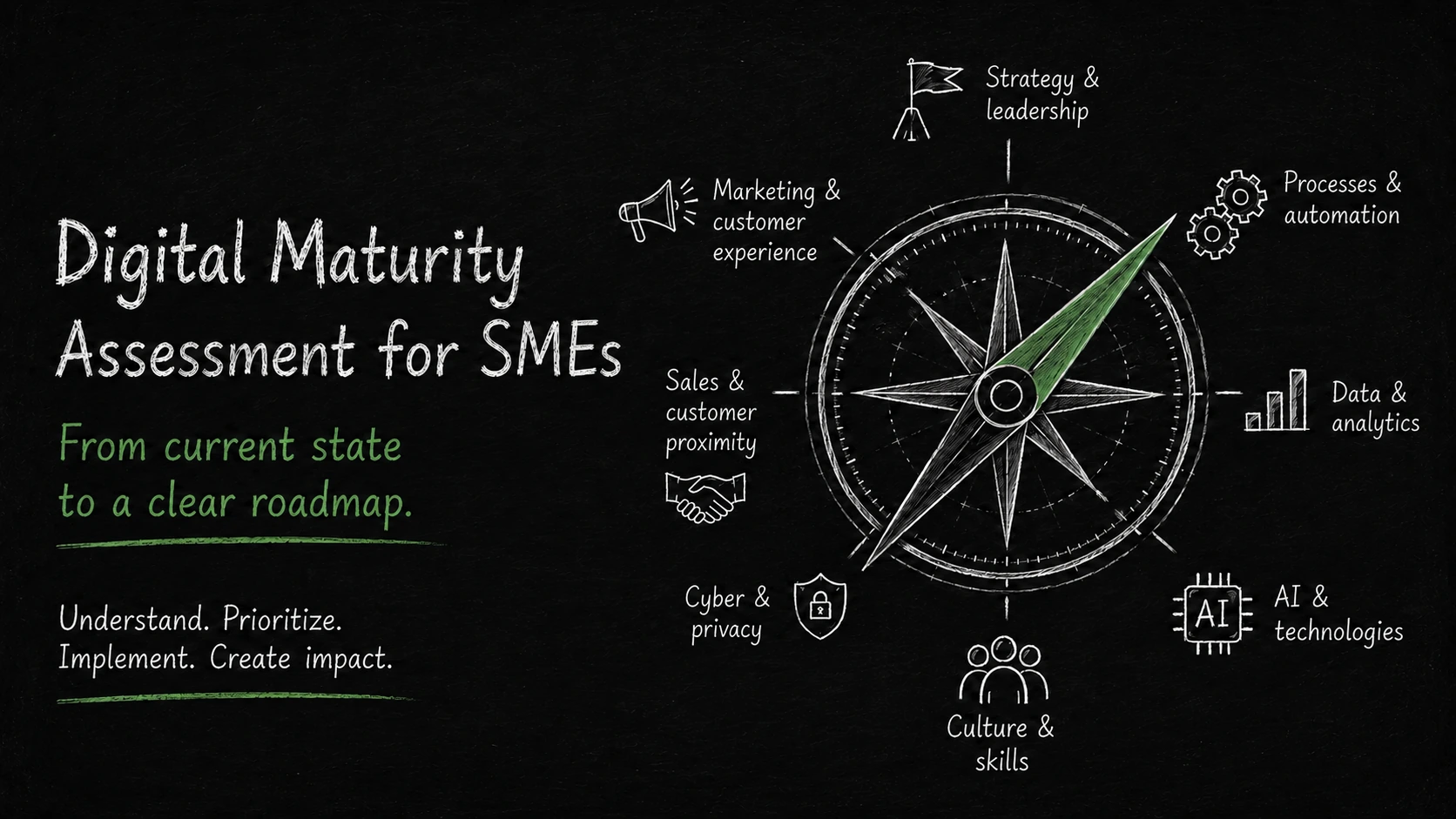
A modern check needs several angles. For SMEs, the typically relevant ones are strategy & leadership, marketing & customer experience, sales & CRM, processes & automation, data & analytics, technology & integration, AI readiness, cyber security & data protection, culture & skills, and innovation & future readiness.
These dimensions aren't a checklist that has to hit 100% everywhere. A manufacturing company needs different priorities than an online shop or a B2B services business.
Measuring digital maturity: combining self-assessment with objective signals
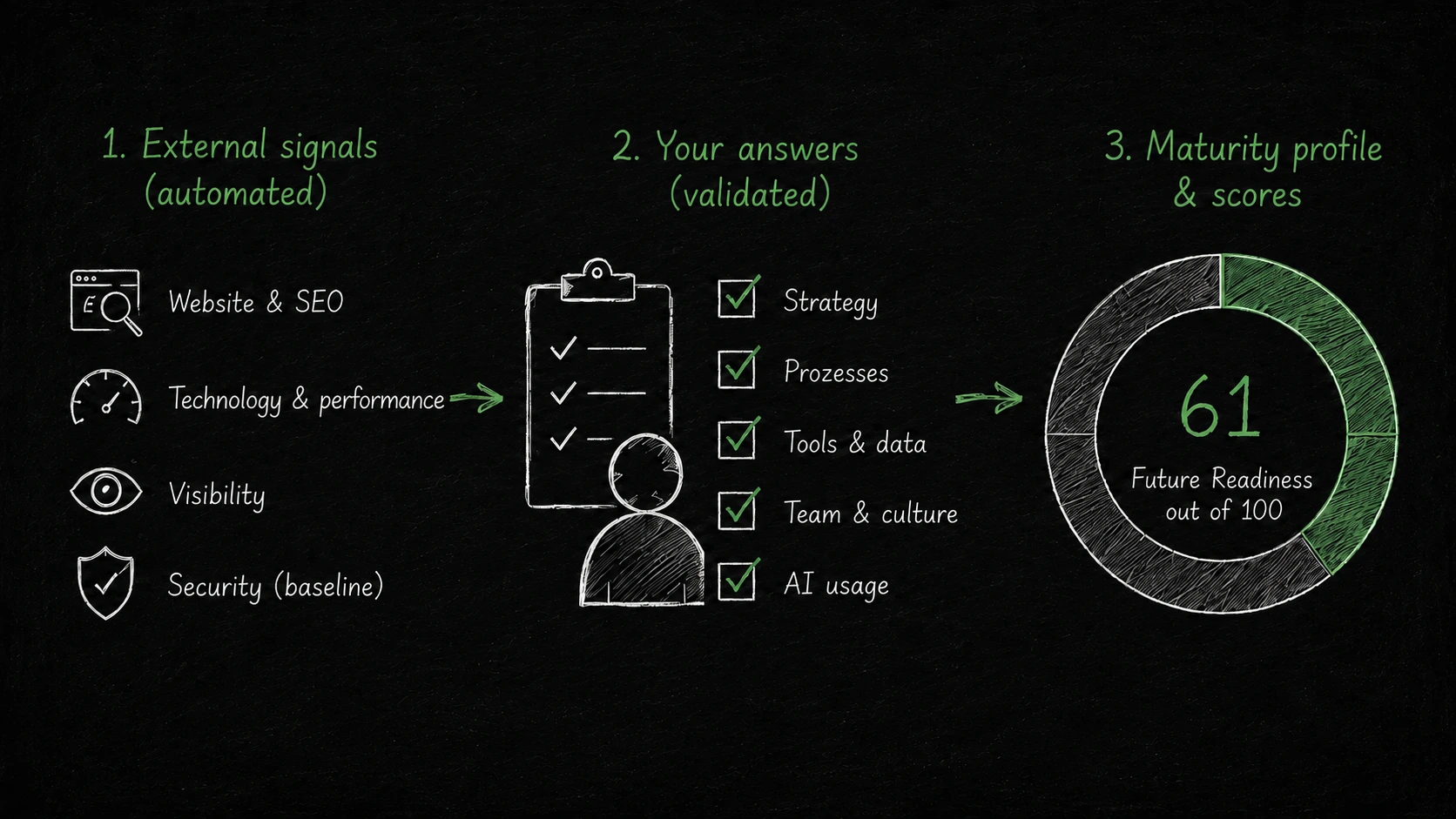
Many classic assessments rely purely on self-reported answers. For internal topics that's indispensable — from the outside, no one can tell whether a CRM is actually used consistently, whether management dashboards influence decisions, or whether a change process is working.
Other signals, though, are measurable: website performance, SEO basics, accessibility, security headers, visible technologies or digital presence. Combining that data with the participant's own answers produces a more robust picture.
Automated research still remains a source of hypotheses, though. A modern check should surface uncertain findings explicitly and let the participant confirm or correct them.
How AI is changing the digital maturity check
AI is relevant on two levels today. First, AI readiness is itself a dimension of digital maturity: are there meaningful use cases, suitable data, governance, skills, integrations and a way to measure business value?
Second, AI can support the assessment itself. It can bring external signals together, spot contradictions, explain hypotheses and phrase results more clearly. That turns a static questionnaire into a smarter assistant.
The distinction matters: AI shouldn't replace the participant with a black box. Evidence, uncertainty and the ability to correct results all need to stay transparent.
What sets a modern check apart from classic maturity tests?
Ordinary online checks often end with a score and a handful of generic recommendations. A modern approach goes further: it connects several dimensions, objectifiable digital signals, AI readiness and context; it shows the concrete topics behind a dimension score; it separates maturity gap from business priority; and it translates results into a handful of actionable steps.
The differentiation isn't a more complicated score — it's better decision support.
How the Digital Maturity Score is calculated - and why it isn't the goal
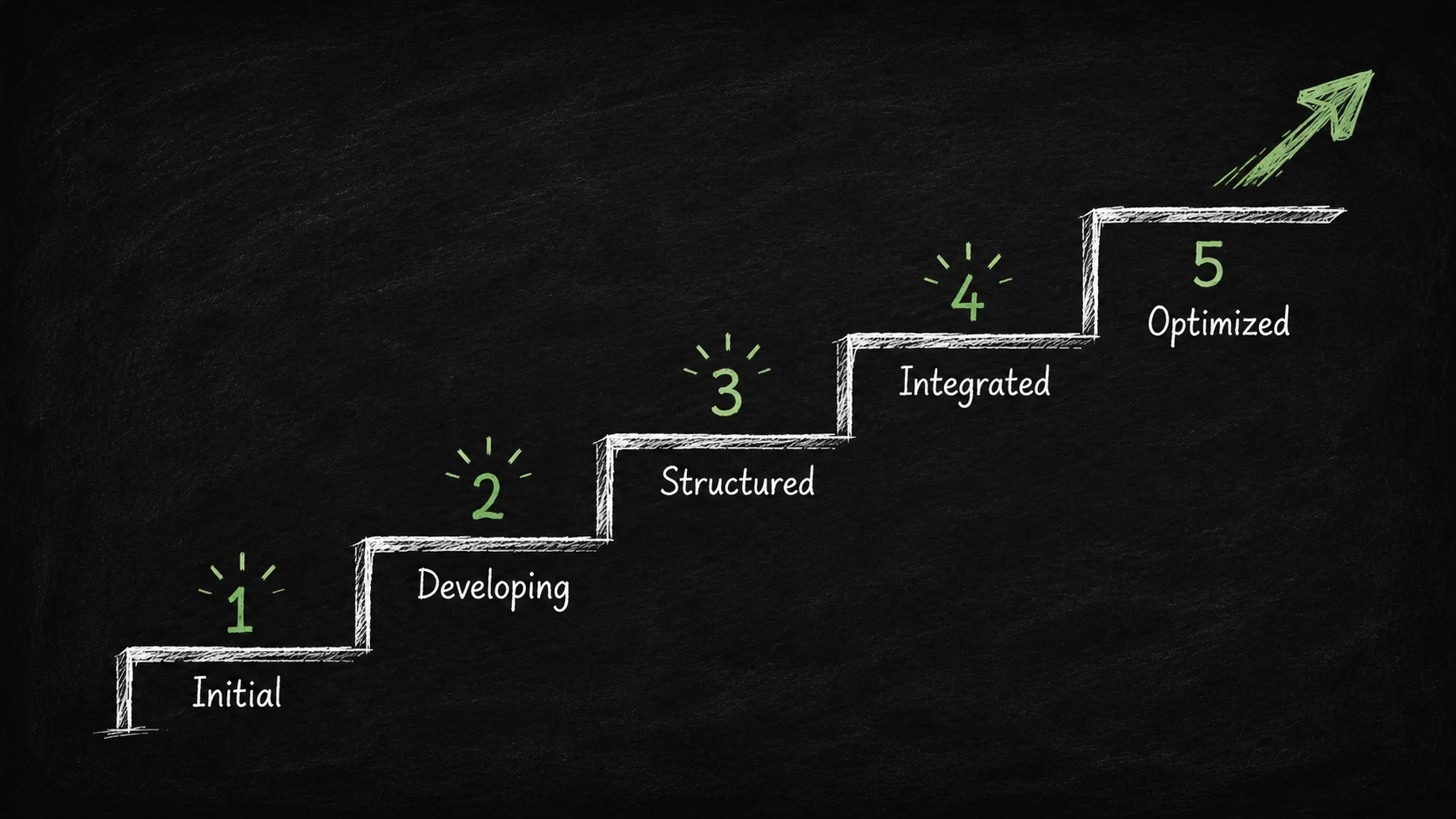
Answers can, for example, be mapped onto a shared scale and normalised to 0–100 per dimension. An overall score then results from weighted dimension values. That math is useful, but it must never create false precision.
The OECD explicitly notes in its own maturity model that there is no universally optimal maturity level. That's central for SMEs too: the right target state depends on business model, market, size and strategy.
From digital maturity to real business potential
A low score doesn't automatically mean top priority. That's why swissICT contrasts relevance and maturity: high relevance plus low maturity creates high urgency to act. For a concrete roadmap, business impact, effort, risk, dependencies and feasibility need to be factored in as well.
A practical mental model: maturity gap × strategic relevance × business impact × feasibility. The AHEAD OF TIME Check operationalises this idea with a transparent, rule-based formula built from business impact and maturity gap - deliberately without invented CHF figures as long as no verified company data is available.
From digital maturity check to prioritised roadmap
A genuinely useful report should therefore deliver more than a score and a radar chart: the key strengths, the most relevant gaps, business potential, quick wins, strategic initiatives, dependencies and a timed roadmap.
The work of Marc K. Peter and FHNW illustrates this follow-through very clearly: maturity analysis, strategic questions, a workshop canvas, templates and a roadmap are treated as one connected transformation process. That matters for SMEs too — an assessment is the starting point, not the end product. That's exactly where our strategy and transformation consulting picks up: from assessment to implementation, not just a workshop photo.
Example: why the same score leads to different measures
A B2B services company scoring 61 points might have a CRM and data problem. An online shop with the same score might be technically solid but losing ground on visibility, conversion and retention. A manufacturing SME, in turn, might mainly suffer from media breaks and missing system integration.
The score is identical. The roadmap can't be. That's exactly why context, sub-dimensions and business priority matter more than chasing the highest possible overall number.
Prioritising quick wins and strategic digitalisation initiatives
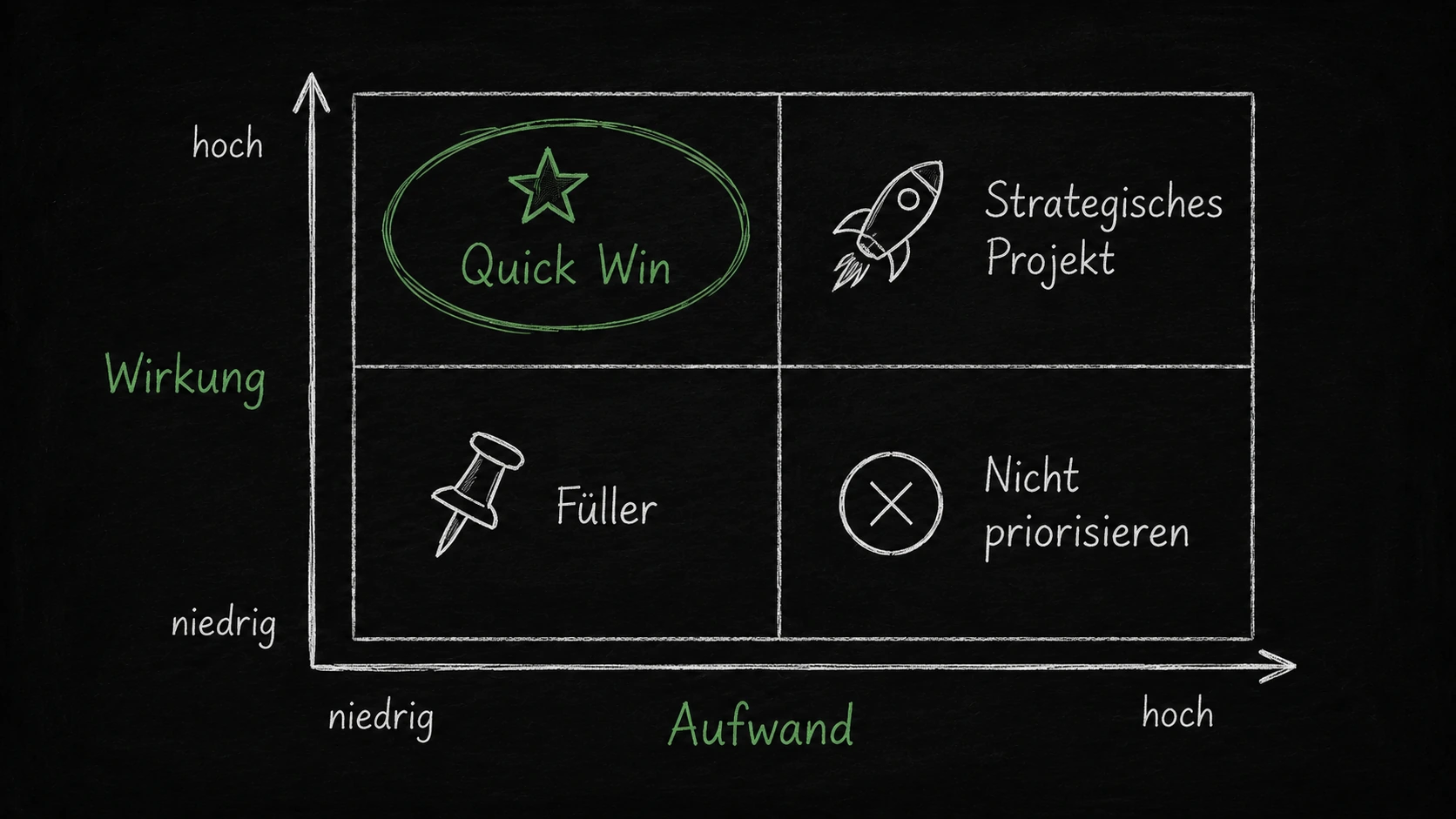
Measures with high impact and manageable effort belong on the quick-win list. High impact with higher effort gets planned as a strategic initiative. Low impact with high effort is a good candidate for "not for now".
Effort isn't just budget. Data quality, internal capacity, skills, technical dependencies, security and organisational change all belong in the assessment too — and this is often where it becomes clear whether a topic needs more process work and software integration or more marketing and SEO work.
Measuring and improving digital maturity continuously
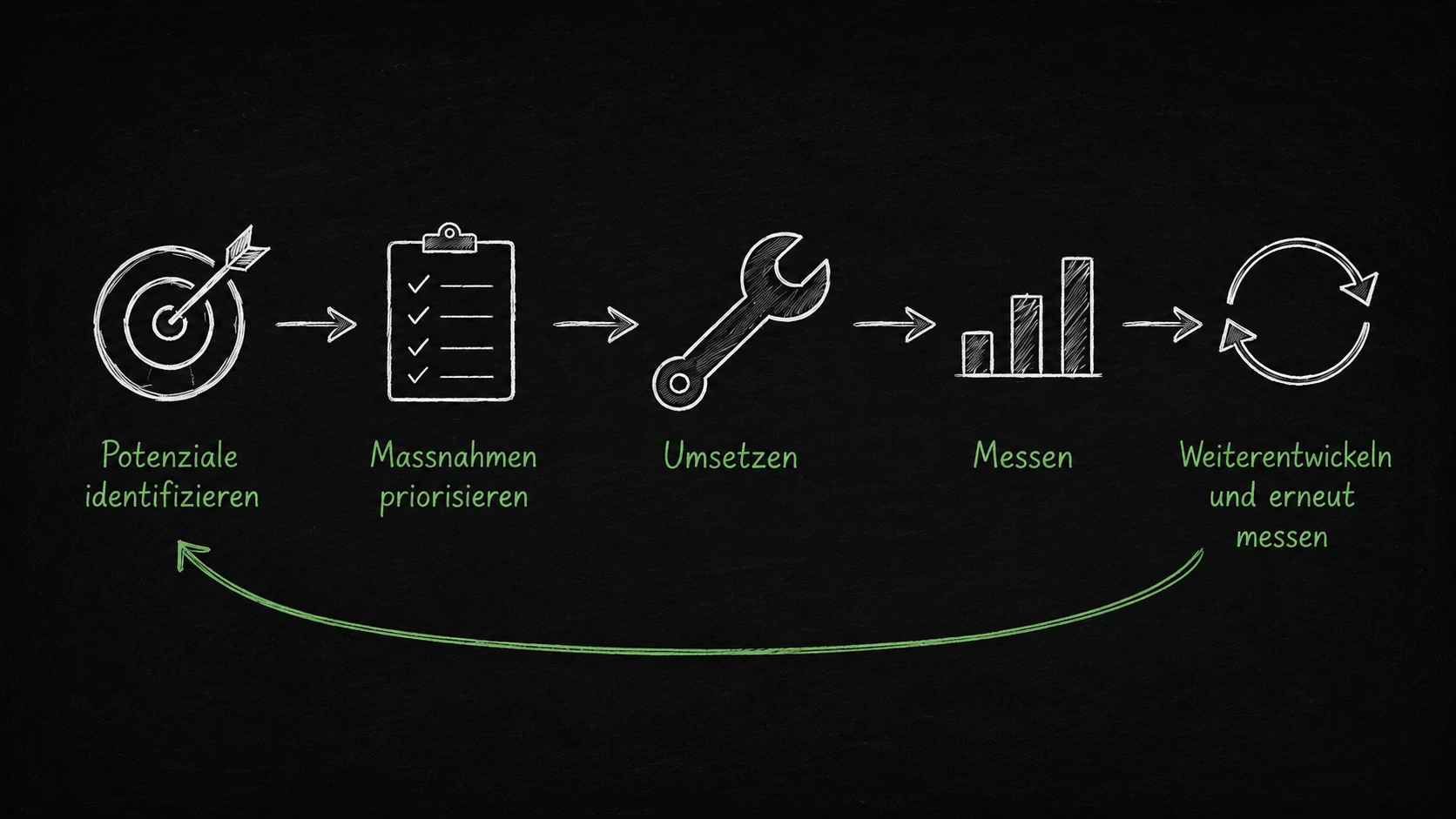
Digital transformation isn't a one-off project. Technologies, markets, customer expectations and skills keep changing. That's why an assessment is especially valuable when it's repeated every six to twelve months.
The sensible cycle: assess - prioritise - implement - measure - reassess. The decisive question then isn't only whether the score went up, but whether the prioritised initiatives actually created impact.
Limits of a Digital Maturity Assessment
A compact check doesn't replace a security audit, a process review or a detailed systems analysis. Self-assessment stays vulnerable to differences in perception. Benchmarks only become robust once there's enough comparable data.
That's exactly why a good assessment should clearly separate facts, self-assessment, hypotheses and reference values.
Where the AHEAD OF TIME Digital Readiness & Potential Check stands today
The AHEAD OF TIME Check combines a compact core questionnaire with automatable digital signals, user verification, and separate views on AI readiness, digital visibility, and cyber security & data protection - the latter including an automated security-header check via the Mozilla/MDN HTTP Observatory. Weighting adapts moderately to business model, industry and company size - a B2C online shop, for example, gets more weight on visibility and customer experience, while a B2B service provider gets more weight on CRM and data analysis.
The report itself deliberately goes beyond a score and radar chart: a detailed website check (SEO, accessibility, performance, security), an overview of visibility and the tech stack in use including an AI-visibility proxy score, a roadmap prioritised across 30/60/90 days, and - because marketing & customer experience is by far the broadest dimension in the questionnaire - a breakdown of that dimension into individual sub-competencies, from audience understanding through personalisation and customer voice to cross-channel measurement and attribution. The full result can also be downloaded as a PDF.
Deliberately not (yet) part of the check: an empirical Swiss market benchmark - today's comparison value is a clearly labelled reference figure based on maturity-model logic, not an average from real surveys. That changes once enough comparable assessments exist.
The methodological basis is deliberately broad: international research and maturity models, government and European assessment frameworks, Swiss models such as swissICT and FHNW, plus years of hands-on experience in digital transformation, product development, marketing and teaching.
Start the Digital Readiness & Potential Check now →
What does a digital maturity check actually give an SME?
The benefit isn't looking "more digital". It's using limited resources better. A good stocktake creates clarity about where the company stands, which potentials genuinely matter, what should happen first, and how to check later whether the investment paid off. If you'd rather have the results put into structure than interpret them alone, our AI workshops and advisory formats are a hands-on way in.
Q&A — digital maturity, digital maturity checks and AI readiness
What does a Digital Maturity Check actually give me?
It creates a shared, structured view of the digital starting point. But the real value only appears once the result distinguishes strengths, relevant maturity gaps, business potential and concrete priorities. A score alone doesn't change anything yet.
How do I check the digital maturity of my company?
Across several dimensions such as strategy, customer experience, processes, data, technology, skills, security and AI. Ideally, self-assessment, objectifiable digital signals and company context are combined.
What is a digital maturity check for SMEs?
A structured stocktake that shows how effectively an SME uses digital capabilities for its business goals. In practice and research you'll also find the terms Digital Maturity Assessment, maturity analysis or maturity scan.
What's the difference between digitalisation and digital transformation?
Digitalisation improves or digitises existing processes. Digital transformation goes further and changes customer experiences, value creation, business models, decision logic, organisation and culture.
What is the goal of digital transformation?
Not using as many technologies as possible, but improving competitiveness, customer value, efficiency, decision quality and adaptability.
Which aspects matter in digital transformation?
Strategy, customers, processes, data, technology, leadership, culture, skills, cyber security, innovation, and today also AI readiness. How these aspects are prioritised differs by company.
How high should an SME's digital maturity level be?
There's no universal target. A local services business needs different capabilities than a digital marketplace or a manufacturing company. What matters is the fit with the business model and strategic goals.
How do I identify the biggest digitalisation potential?
Not automatically at the lowest score. A gap becomes relevant when strategic importance and expected business impact are high and implementation is realistic.
How does a check turn into concrete measures?
Gaps and opportunities are prioritised by impact, relevance, effort, dependencies and feasibility. That produces quick wins, strategic initiatives, ownership, KPIs and a roadmap.
How often should an SME check its digital maturity?
For many SMEs, repeating it every six to twelve months makes sense. What matters is whether the progress and impact of the prioritised initiatives are measured, and whether the roadmap is adjusted afterwards.
Can AI automatically analyse digital maturity?
Partly. Website, performance, SEO, accessibility, visible technologies and other public signals can be checked automatically. Strategy, culture, internal processes or actual system usage still need validated input from the company.
What does AI readiness have to do with digital maturity?
AI builds on digital foundations: data, processes, governance, skills, integration and security. That's why AI readiness should be made visible separately today, without replacing the classic transformation dimensions.
How can AI improve a digital maturity check?
AI can bring external signals together, formulate hypotheses, spot contradictions and explain results clearly. It should serve as an assistant; uncertain findings need to stay transparent and verifiable by the participant.
Is a Digital Maturity Assessment scientifically exact?
An assessment is a model, not a law of nature. Dimensions can be well evidence-based, while concrete weights and thresholds still need to be calibrated and validated. Transparency about assumptions and limits matters more than false precision.
Sources and further reading
- Solis, B. (2016). The Six Stages of Digital Transformation Maturity. Altimeter Group / Cognizant. https://www.cognizant.com/us/en/insights/insights-blog/the-six-stages-of-digital-transformation-maturity
- Teichert, R. (2019). Digital Transformation Maturity: A Systematic Review of Literature. Acta Universitatis Agriculturae et Silviculturae Mendelianae Brunensis, 67(6), 1673-1687. https://doi.org/10.11118/actaun201967061673
- OECD (2022). Digital Transformation Maturity Model. OECD Forum on Tax Administration. https://www.oecd.org/tax/forum-on-tax-administration/publications-and-products/digital-transformation-maturity-model.htm
- European Commission JRC (2023/2024). Digital Maturity Assessment Framework and Questionnaire for SMEs, European Digital Innovation Hubs. https://european-digital-innovation-hubs.ec.europa.eu/knowledge-hub/guidance-documents/overview-digital-maturity-assessment-tool-dmat
- Australian Government DTA (2026). Digital Maturity Assessment guide. https://www.digital.gov.au/enabling-government/digital-maturity-assessment/guide
- Peter, M. K. / FHNW. SME transformation: maturity analysis, Digital Transformation Canvas and the ACT strategy process. https://kmu-transformation.ch/
- swissICT / BFH / FHNW (2023). Digital Excellence Checkup and Digital Excellence Report. https://www.swissict.ch/digitale-transformation-handlungsbedarf-besteht/
- PwC Switzerland / Google Switzerland / digitalswitzerland (2016). Digital transformation: How mature are Swiss SMEs? https://www.pwc.ch/en/publications/2016/pwc_digital_transform_how_mature_are_swiss_smes_survey_16_en.pdf
- TM Forum (2017). Digital Maturity Model & Metrics (GB997). https://www.tmforum.org/resources/how-to-guide/gb997-digital-maturity-model/
- O'Boyle, S. / Heavy Reading (2016). The Digital Maturity Model & Metrics Accelerating Digital Transformation. (Huawei-commissioned study)
- Government of South Australia. Digital Strategy Toolkit - Digital Maturity Assessment Tool: Governance & Leadership, People & Culture, Capacity & Capability, Innovation, Technology.
- OECD (2026). SME AI Readiness Tool - pilot version based on the OECD taxonomy for AI adoption in SMEs. https://sme.oecd.ai/
- Swiss Confederation - SME Portal. Digitalisation as a multi-stage process: from analysing digital maturity to implementation. https://www.kmu.admin.ch/de/digitalisierung-als-mehrstufiger-prozess
This list covers the main sources for the concepts discussed in this post. It isn't exhaustive, but offers a starting point for anyone who wants to go deeper.